The millimeter dilemma: Why small measurement errors during roller replacement have big consequences
27.07.2026
It's every maintenance manager's nightmare: a key conveyor roller fails, threatening a production standstill. Luckily, the replacement part is quickly ordered. But installation brings a rude awakening – the axle protrudes a few millimeters too far, or the tube rubs against the frame. The roller doesn't fit. What follows is frantic rework, express returns, and valuable hours of production downtime.
In mechanical engineering, success or failure often hinges on millimeters. When old plant documentation is incomplete, maintenance personnel have to resort to calipers themselves. To ensure nothing goes wrong, we've compiled a practical guide. This will help you determine the dimensions of your conveyor rollers with absolute accuracy.
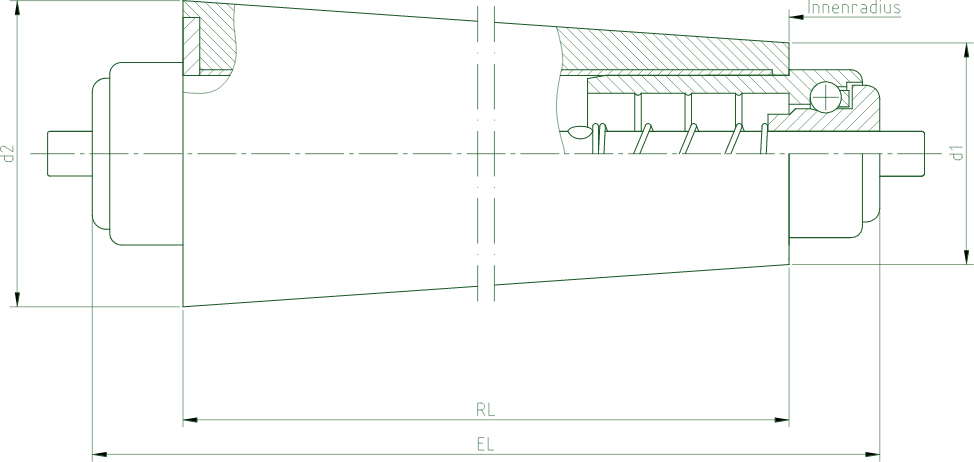
The three sacred dimensions of conveyor technology: RL, EL and AL
- The roll length (RL) or sleeve length: This is the visible width of the pipe only. Important: Measure only the pipe itself, not the bearing ends or sealing caps protruding from the sides!
- The installation length (EL): This is arguably the most critical dimension. The installation length describes the clear distance between the two inner sides of your system frame (i.e., the space physically available to the roller). An error of just 2 mm will cause the roller to either jam or fall out.
- The axle length (AL) or overall length: The total measurement from one end of the axle to the other. This measurement is particularly important if the axle is screwed firmly into the frame or secured with cotter pins.
Important when measuring spring axles: If your reel has a compressed spring axle, measure the axle length in its completely relaxed state. Also, be sure to note the spring travel so that the axle slides deep enough into the frame hole when it engages.
Pay attention to the details: The axle design
A perfectly measured tube is useless if the axle end doesn't fit into the frame's receptacle. Always ask yourself the following questions before ordering:
- Is this a threaded shaft (internal or external thread)? If so, what metric (e.g., M10, M12)?
- Does the axle have a flat grinding pattern (double flat)? Here, the wrench size (SW) and the depth of the grinding must be determined precisely to prevent the axle from rotating during operation.
- Is it a simple rigid axle with a transverse bore?
Avoid errors by using standardized queries
To ensure maximum safety, it is recommended to always make a sketch if dimensions are unclear, or to send digital photos of the nameplate (if available) and the axle ends with a caliper held next to it directly to the manufacturer.
Conclusion: Precision in measurement ensures the flow
Replacing a conveyor roller is routine – however, proper measurement should never be neglected. Using the correct procedure will save you time, hassle, and money. If you have any questions, don't hesitate to contact our engineers directly.
Do you need custom-made replacement rollers quickly and easily?
Take it now Contact up with us!




 Call
 E-mail
 Location